Virtual connections become reality on country
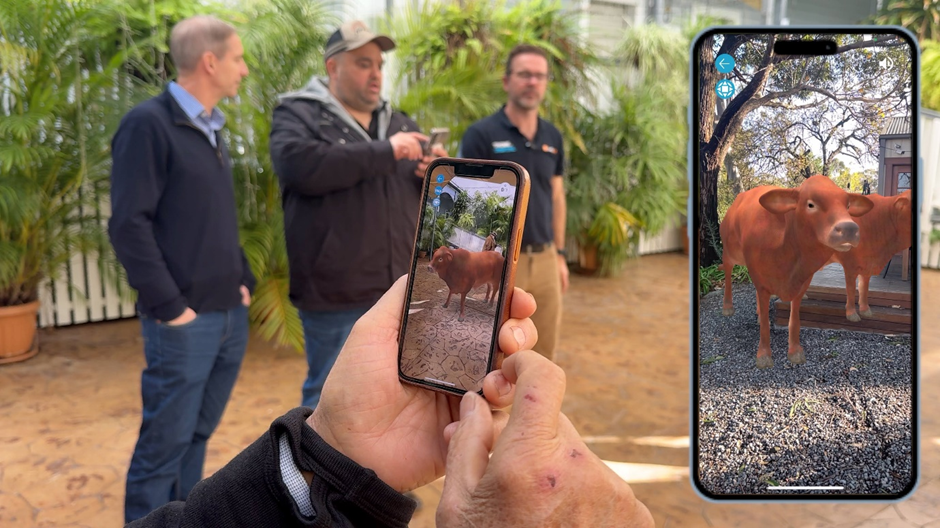
Caption: The Cattle EAD app trains participants to identify biosecurity issues in their actual herds by projecting images of virtual animals displaying various signs of EADs. Pictured left to right at the Mt Isa workshop are Rob Barwell (AHA), Thomas Holden (Nirrwara Global and Chair of Girringun Aboriginal Corporation) and Tim Gentle (Think Digital). Image: Think Digital
An MLA-supported Northern Breeding Business (NB2) project is using virtual reality to bridge the divide between remote Indigenous beef enterprises and access to the latest biosecurity training.
A virtual farm tour and augmented reality experience app are proving engaging and
effective ways to upskill users in how to recognise emergency animal diseases (EAD) in cattle and protect Australia’s biosecurity.
Co-funded through MLA Donor Company, the Indigenous Land and Sea Corporation
(ILSC) and Animal Health Australia (AHA), the project’s approach ensures the participating Indigenous-run cattle enterprises are the drivers of their own business growth, professional development and management goals.
NB2 group facilitator Ian Perkins is a passionate advocate for the program’s capacity building framework.
“One of the strengths of the group has been the willingness to share and the openness to learn from each other,” he said.
One of the tools is a ‘virtual reality campfire chat’, which builds on these strengths.
“It’s a unique management tool that takes advantage of the opportunities offered by innovative technology to involve and engage Indigenous participants,” Ian said.
“It utilises Indigenous story-telling and harnesses participants’ interests, abilities and experiences to achieve outcomes which combine non-Indigenous ways of presenting and consuming information with Indigenous ways of being and doing.”
Removing barriers
ILSC Chief Operating Officer, Matthew Salmon, noted the NB2 program’s importance in providing communities access to professional development and training opportunities in technological spaces.
“There have been many powerful outcomes of this program – in particular, removing barriers for Indigenous people who are caring for and managing Country,” Matthew said.
“This has ultimately helped empower First Nations groups to achieve greater self-determination – which forms part of the ILSC’s core mission.”
Virtual reality
Tim Gentle, founder of the project’s immersive technology provider Think Digital, is keen
to showcase the potential of augmented and virtual reality to bring the digital and real worlds together.
“We see the technology as a way of not only building connections between users and the learning they’re engaging with, but also with their peers in other communities and locations across northern Australia,” Tim said.
Creating a network where Indigenous landholders can work together to share experiences, data, knowledge and successes has been powerful.
Bringing communities together to solve problems collectively, rather than in isolation, was a key project goal and one which inspired Tim to facilitate a virtual ‘fireside chat’ at a workshop with participants from several Indigenous enterprises at Mt Isa in June 2025.
After donning the virtual reality headsets and generating personalised avatars for themselves, they discussed management strategies around the ‘fire’.
While in this instance everyone was in the same room, Tim explains the technology enables people from various locations to connect in a fun and engaging way to share knowledge and nut out any business or on-farm challenges they’re facing.
Biosecurity benefits
For Rob Barwell, Head of Program – Biosecurity, at Animal Health Australia, the biosecurity virtual farm tour developed as part of the project not only provides an immersive and memorable learning experience, but also adds meaningful value to the Indigenous enterprises involved in the project.
“This type of immersive professional development goes beyond simply accessing training and information. We have developed the tool with Indigenous staff delivering the content in a relatable way,” Rob said.
“There are opportunities to expand this training into workplace health and safety, staff induction and even the sharing of cultural knowledge for future generations.”
On the tour, brothers Kawane and Jon Motlop – station hands at ‘Bulimba Station’ – present biosecurity information in a range of key locations via pre-recorded videos. These include the homestead, property entrance, sheds and watering points.
The tour can be taken online via a phone or computer or by using a virtual reality headset at a field day or in a workshop setting. The headset allows users to swivel their heads to look around the property and then click on various locations to access more information and watch the videos.
Take the biosecurity virtual tour.
A virtual herd in the palm of your hand
The project also saw the development of the Cattle EAD augmented reality app where users can engage in immersive play to learn how to recognise EADs.
Digital cows are projected into the real world with users simply requiring a smart phone and blank background. The 3D cows can be inspected from all angles as users determine which signs indicate a range of EADs.
“It means people can access training in their own environment – it helps overcome distance and lack of resources,” Rob said.
“It can be a considerable distance to the nearest vet and animals may only be yarded once or twice annually, usually for branding, weaning or selling livestock.”
The virtual farm tour and app are proving to be impactful, novel ways of delivering training which may encourage deeper knowledge retention than more passive training modes such as reading printed materials or watching a PowerPoint presentation.
|
The app is freely available to producers or anyone handling cattle who is keen to improve their biosecurity awareness. Follow the relevant link below to download the app. |
Disease frontline
Most of the project’s Indigenous cattle stations are located in northern Queensland, with modelling indicating they are key potential entry points for some EADs. It makes
them ideally placed to identify any early incursions of those EADs.
“Extra eyes looking out for diseases to Australia’s north such as foot-and-mouth disease and lumpy skin disease are a great boost to our biosecurity capacity,” Rob said.
“Keeping up good biosecurity practices will also mean lower levels of endemic diseases and pests and therefore better productivity, which in turn will lead to better profitability for these businesses.”
If producers see anything unusual in their livestock, they should call the EAD Hotline: 1800 675 888 as early reporting is a vital opportunity to get a handle on any potential outbreak of disease.
More information
Contact:
Rob Barwell
E: rbarwell@animalhealthaustralia.com.au
Tony Parker
E: tparker@mla.com.au
Resources:
- Visit the Animal Health Australia website.
- Find out more about the Indigenous Land and Sea Corporation.
- View the Think Digital website.
- Access northern cattle tool and resources.
- More information on biosecurity from Integrity Systems.
- Visit the Farm Biosecurity website.
- Find out more about the NB2 program.