From by-product to asset: Managing pre-farm gate waste
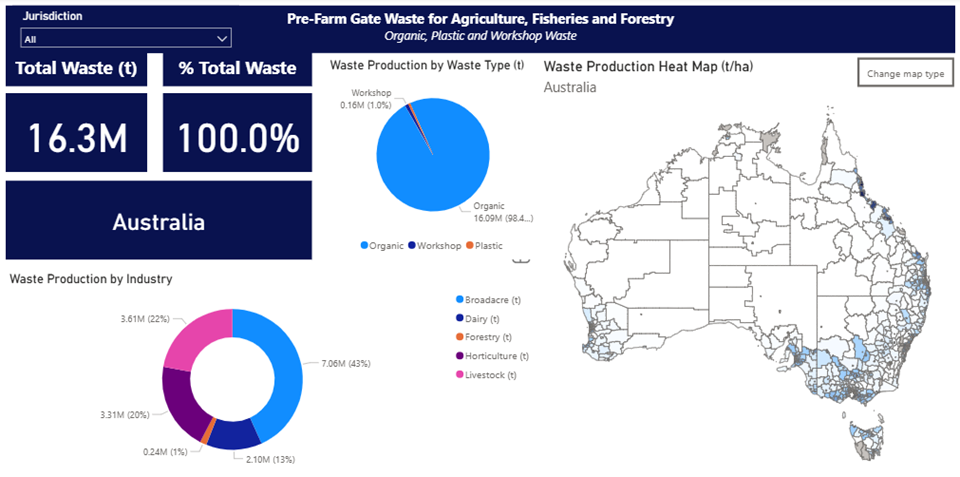
Caption: Pre-farmgate waste dashboard.
The new Pre-Farm Gate Waste Data Dashboard provides users with a clearer national picture of waste generated across Australian agriculture, highlighting opportunities to manage it more effectively and efficiently.
Developed by AgriFutures Australia in partnership with RM Consulting Group, the interactive dashboard establishes a national baseline for pre-farm gate waste and delivers practical insights to support smarter on-farm decision making.
Pre-farm gate waste includes organic material, plastics and workshop waste generated during production and harvest, before livestock or products leave the farm. By measuring and mapping these waste streams across commodities and regions, the dashboard presents waste in measurable, comparable terms. This turns an abstract issue into something that can be benchmarked and actively managed.
Better information supports better decisions. Whether the opportunity lies in targeted infrastructure investment, improved nutrient management or more efficient reuse and recycling systems, the goal is the same: reduce avoidable losses and improve overall efficiency.
Understanding the scale of agricultural waste
The scale of pre-farm gate waste across Australian agriculture is significant. In 2020–21, the agriculture, fisheries and forestry sectors generated an estimated 16.3 million tonnes of pre-farm gate waste.
Red meat livestock accounted for 6.11% of total agricultural pre-farm gate waste in 2021, equivalent to about 996,000 tonnes. Importantly, 95.9% of this material was organic waste, primarily animal manure.
While classified as waste for reporting purposes, organic material often represents a valuable on-farm resource. When managed effectively, it can enhance soil health, support nutrient cycling and reduce erosion. Understanding the volume, composition and movement of this material helps producers design systems that capture value while minimising avoidable waste.
Supporting sustainability and continuous improvement
For the red meat industry, access to consistent national data supports progress under the Australian Beef Sustainability Framework (ABSF) waste priority. The dashboard provides evidence of ongoing improvement and helps inform future investment and innovation.
Importantly, the platform does not collect individual farm-level data. Instead, it draws on ABARES production statistics, industry survey data and insights from producers, Rural RDCs and waste experts to generate sector-wide baseline estimates. This approach ensures the data reflects real production systems while protecting individual business information.
Public access to this data also helps identify practical solutions that can be implemented at scale, reducing duplication of effort across regions and supply chains.
Turning insight into action
The dashboard is hosted on the Australian Farm Waste Portal, alongside practical guides, case studies and tools designed to help translate data into action. A short how-to video walks users through the platform and shows how insights can be applied to individual operations.
These resources are designed to support adoption across a wide range of business sizes and production systems.
Ultimately, success depends on producers actively engaging with the information to benchmark their operations, review existing waste streams and identifying incremental improvements. Viewing organic waste as an input rather than a by-product can unlock productivity gains while supporting long-term land condition.
Producers are encouraged to explore the dashboard, compare their enterprise against industry benchmarks and use the supporting resources to identify practical next steps.
Improving how pre-farm waste is measured and managed strengthens efficiency, supports sustainability objectives and builds resilience for the future.
More information
Contact:
Jacob Betros
Resources:
- View the Pre-Farm-Waste-Factsheet.
- Visit the Australian Beef Sustainability Framework website.
- Find out more about AgriFutures Australia.
- Visit the Australian Farm Waste Portal.